My interest in this topic is centered around works, whether cinematic or literary, that push us to think beyond anthropocentric worldviews and interrogate the relationships between humans and other living and non-living beings. This project has taken me to examine the representations of plants, animals, robots, and other non-human beings in films, novels, and short stories from Spain and Latin America that pay special attention to human and non-human entanglements.
Mi interés en este tema se centra en obras, ya sean cinematográficas o literarias, que nos empujan a pensar más allá de visiones antropocéntricas del mundo e interrogar las relaciones entre humanos y otros seres vivos y no vivos. Este proyecto me ha llevado a examinar las representaciones de plantas, animales, robots y otros seres no humanos en películas, novelas y cuentos de España y América Latina que ponen particular atención a los entrelazamientos de humanos y no humanos
Publications | Publicaciones
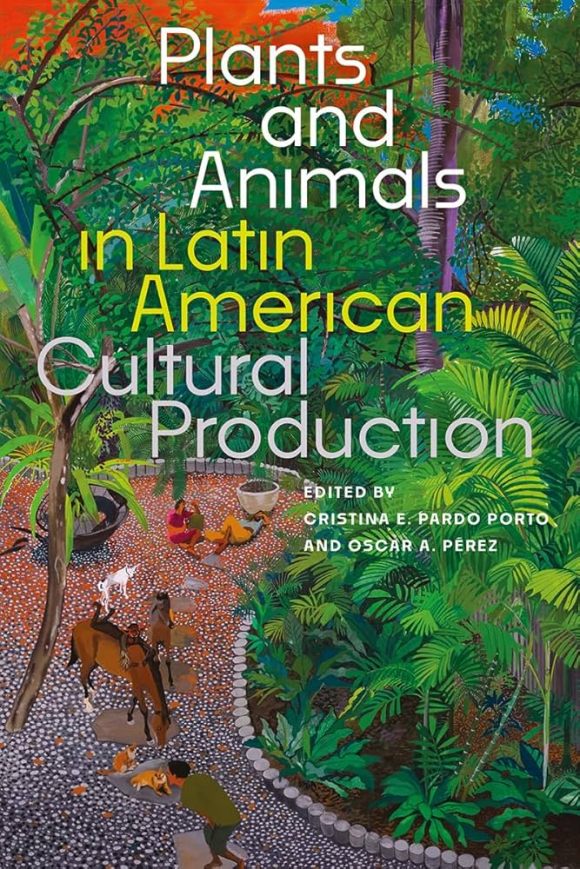
Plants and Animals in Latin American Cultural Production promotes a deeper understanding of cultural forms in Latin America and breaks down disciplinary divides—both between critical animal studies and critical plant studies and between fields such as literary studies, film studies, and art history. Ultimately, this collection challenges anthropocentric perspectives as it offers new pathways to think about and with plants and animals.
Contributors analyze a wide range of cultural production, including recent science films on monarch butterfly migration, nineteenth-century photographs of Panama, the eighteenth-century diary of a nun in New Granada, 1920s Brazilian landscape paintings, contemporary Zapotec poetry, and twentieth-century vegetarian cookbooks from Uruguay and Mexico. These essays uncover the entanglements of nonhuman lives with issues such as race, gender, labor, and coloniality, while highlighting other-than-human ways of living, knowing, and communicating.
With Bella Klosterman. “Dos visiones del futuro: ficción especulativa y cambio climático en la literatura mexicana contemporánea.” Catedral Tomada, vol. 12, no. 22, 2024, pp. 298-321. [webpage]
“Poshumanismo y capitalismo digital en Kentukis de Samanta Schweblin.” Hispanic Studies Review, vol. 6, no. 1, 2022, pp. 1-17. [webpage]
“‘He Did Not Know Which of the Two Shadows Was His’: A Posthumanist Reading of Amparo Dávila’s First Short Story Collection.” Humanística, vol. 2, no.3, 2021, pp. 68-83. [webpage]
“Local Landscapes, Global Conversations: The Case of Three Environmental Documentary Films from the Hispanic World.” Environmental Cultural Studies Through Time: The Luso-Hispanic World, special issue of Hispanic Issues On Line, edited by Kata Beilin, Kathleen Conolly, and Micah McKay, vol. 24, 2019, pp. 65–78. [webpage]
Special Issues | Dossiers
Border Environments: Toward a Political Ecology of the Edges of the World
A project funded by the Central New York Humanities Corridor and co-organized by Debra Castillo (Cornell), Anindita Banerjee (Cornell), Gail Bulman (Syracuse), Oscar A. Pérez (Skidmore), and Beth Jörgensen (Rochester).
Reviews | Reseñas
Review of Josephine Donovan’s Animals, Mind, and Matter: The Inside Story. H-Environment, H-Net Reviews. April 2023. [webpage]
Review of Lesley Wylie’s The Poetics of Plants in Spanish American Literature. H-Environment, H-Net Reviews. June 2021. [webpage]
Projects
Sky Imaginaries in Latin American Literature, Film, and Art
Plants and Animals in Latin American Cultures
 Oscar A. Pérez